


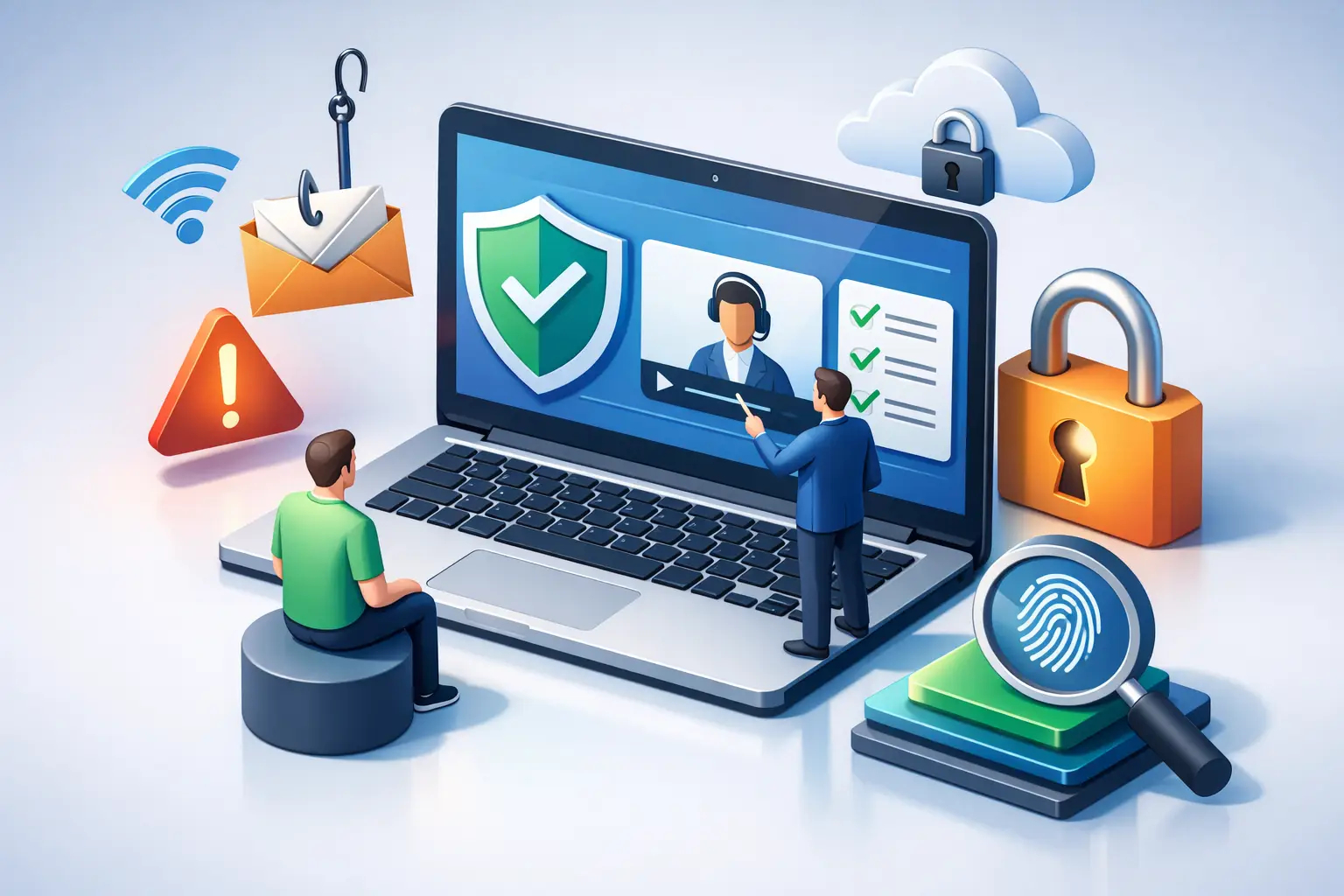
Security Awareness Training Platform Review
Most security awareness programs fail for a simple reason: the buyer evaluates content libraries and phishing templates, while the business actually needs measurable behavior change. That is the real lens for any security awareness training platform review. If your review process starts and ends with feature checklists, you may buy software that looks mature in a demo but does little to reduce reporting gaps, credential risk, or compliance exposure.
For executive teams, IT leaders, and compliance owners, this category is not just an HR add-on or a low-cost control to satisfy auditors. It sits at the intersection of operational risk, employee behavior, policy adoption, and incident prevention. A strong platform can support governance and resilience. A weak one becomes another underused subscription with inflated completion rates and no real business impact.
How to approach a security awareness training platform review
Start with the business problem, not the vendor shortlist. Some organizations need to reduce phishing susceptibility across a distributed workforce. Others need stronger audit evidence, role-based training for privileged users, or global policy attestation tied to regulatory obligations. Those are not the same buying motions, and they should not produce the same purchasing decision.
A serious review should ask three questions early. What risk are you trying to reduce? What proof will show the platform is working? Who will own the program after implementation? If those answers are fuzzy, the platform selection will be fuzzy too.
This is where many mid-sized businesses lose momentum. Security owns the risk, HR owns training logistics, compliance owns evidence, and IT owns identity and user data. If no one has clear authority, even a strong platform will struggle. Cybersecurity requires leadership, not just tools, and awareness software is a good example of that rule.
What actually matters in platform evaluation
Content quality matters, but not in the way vendors usually present it. A library with thousands of modules sounds impressive. It is less impressive if the material is repetitive, culturally tone-deaf, too generic for your workforce, or impossible to tailor by role. Better content is concise, current, and relevant to the threats your staff actually face, whether that means business email compromise, invoice fraud, social engineering, data handling, or safe use of generative AI.
Phishing simulation capabilities also deserve a closer look. The issue is not whether a platform can send simulated phishing emails. Almost all of them can. The real question is whether the simulations help you identify risky behavior patterns, train without alienating staff, and segment campaigns based on role, geography, or threat exposure. If every campaign feels punitive, the program can damage trust and reduce reporting rather than improve it.
Administrative usability is another deciding factor. Many platforms look polished for end users but create heavy lift for the team managing enrollments, reporting, exclusions, and follow-up actions. If your internal team is already stretched, complexity becomes cost. A platform that saves ten minutes per task across hundreds of admin actions may be more valuable than one with extra features nobody uses.
Reporting is where executive buyers should be especially skeptical. Dashboards often look strong in demos because they focus on participation metrics - completion rates, click rates, campaign counts, and average scores. Those metrics are useful, but they are not the same as risk reduction. A credible platform should help you track trends over time, identify repeat offenders or high-risk groups, map training outcomes to incidents or reporting behavior, and export evidence cleanly for audits or board reporting.
The trade-offs vendors do not highlight
There is no perfect platform. There are trade-offs, and your decision should be explicit about them.
A content-heavy platform may be ideal for organizations with broad compliance needs and limited time to build material internally. But those same platforms can feel generic if your workforce needs industry-specific scenarios or role-based depth. A more customizable platform may support stronger targeting, yet it often requires more internal effort to manage campaigns and maintain quality.
Some vendors are excellent for phishing simulation but weaker in policy acknowledgment, third-party learner support, or executive reporting. Others are strong in compliance workflows but less compelling for behavior-based reinforcement. If your business is under regulatory pressure, evidence collection may carry more value than advanced gamification. If you are recovering from repeated social engineering incidents, behavioral analytics may matter more than a broad compliance library.
Budget trade-offs also need honest treatment. A lower-priced platform can look efficient at purchase and expensive six months later if key capabilities are locked behind add-ons, reporting is limited, or the admin burden falls on already overloaded security staff. A more expensive platform may be justified if it reduces operational effort, improves audit readiness, and supports a more mature program over time.
Key areas to test during a platform review
A real review process should move beyond slideware. Ask vendors to show exactly how the platform handles user provisioning, role-based assignments, policy acknowledgment, phishing remediation, multilingual support, and reporting for both managers and executives.
Pay attention to how quickly meaningful tasks can be completed. Can your team assign targeted training to finance users exposed to wire fraud risk? Can you automate remedial training after a phishing failure? Can you produce a compliance-ready report without manually stitching exports together? Can managers see the status of their own teams without creating a separate reporting project?
Integration matters too, but it should be viewed through operating model, not marketing claims. A platform that connects to identity providers, HR systems, ticketing workflows, or SIEM tooling may strengthen your program. Still, integrations only add value if your team will actually use them. It is better to have three useful integrations than ten theoretical ones.
Security awareness training platform review criteria for leadership teams
Leadership teams should evaluate platforms against business outcomes, not just security features. That means asking whether the platform supports governance, risk reduction, and workforce accountability at the level your organization needs.
If you are a growing company without a full in-house security leadership function, simplicity and clarity may be more valuable than advanced customization. You need a platform that helps establish cadence, evidence, and measurable improvement fast. If you are a larger enterprise with multiple regions, regulated operations, and diverse user groups, then localization, delegated administration, and reporting depth become more important.
This is also where procurement decisions often go sideways. The cheapest option may satisfy a line item. It rarely satisfies a long-term maturity objective. A platform should be judged on whether it supports the next stage of your security program, not just this quarter's budget pressure.
Common buying mistakes
The first mistake is confusing engagement with effectiveness. Employees may like the training and still fall for credential theft lures. Completion rates can hit 99 percent while risky behavior remains unchanged.
The second mistake is buying for compliance only. Compliance matters, and audit evidence matters, but checkbox training alone rarely improves resilience. If the platform cannot reinforce real-world judgment and reporting habits, it will not meaningfully strengthen your human layer.
The third mistake is underestimating program ownership. Awareness platforms do not run themselves. Someone needs to define cadence, approve messaging, monitor results, and coordinate across security, HR, and compliance. Without that structure, adoption stalls.
The fourth mistake is ignoring culture. An aggressive simulation program may work in one company and backfire in another. A review should consider how the platform supports positive reinforcement, not just failure tracking.
What a good decision looks like
A good platform decision is rarely about choosing the vendor with the longest feature list. It is about selecting the one that best fits your risk profile, operating capacity, compliance obligations, and workforce reality.
For some organizations, that means prioritizing rapid deployment, strong default content, and straightforward reporting. For others, it means deeper customization, segmentation, and integration into broader governance workflows. The right answer depends on where your security program is today and what maturity level you need to reach next.
That is why the strongest buyers treat platform review as part of a broader security leadership conversation. If awareness training is disconnected from policy, incident response, access risk, and executive reporting, it will remain a silo. If it is tied to governance and measurable outcomes, it becomes far more valuable. This is the same business-first approach CISOLead applies across security decision-making: controls should support resilience, accountability, and growth, not just fill procurement gaps.
When you review security awareness platforms, do not ask which vendor has the flashiest interface. Ask which one will help your organization make fewer avoidable mistakes, prove progress credibly, and build a stronger security culture without creating operational drag. That is the decision that holds up after the demo ends.
FAQ
1. What should you actually evaluate when choosing a security awareness platform?
Not the module catalog or phishing templates, but the platform’s ability to change behavior. If you evaluate only features, you may buy a product that looks mature in a demo but does not reduce risk.
2. Why does “a lot of content” not mean “good content”?
Large libraries are often repetitive, generic, or culturally misaligned. Better content is short, current, and relevant to real threats: BEC, invoice fraud, social engineering, data handling, AI misuse.
3. What matters most in phishing simulations?
Not whether the platform can send phishing emails — they all can. What matters is whether simulations identify risky behavior, allow segmentation by role/region, and train without damaging culture.
ADVANCED VISION IT - MALTA Address: Suite 8, Ta’ Mallia Buildings, Triq In‑Negozju, Zone 3, Central Business District, Birkirkara, CBD 3010, Malta
Registration number: C111282, VAT Number: MT31713827
Phone:+35679224404
Email: office@advisionit.com
ADVANCED VISION IT - BULGARIA
Address: 35 Dimitar Hadzhikotsev str. Ent A, Lozenets, Sofia, Bulgaria
ID No: 205789039, VAT No: BG205789039
Phone: +359 888 258 530
Email: office@advisionit.com