


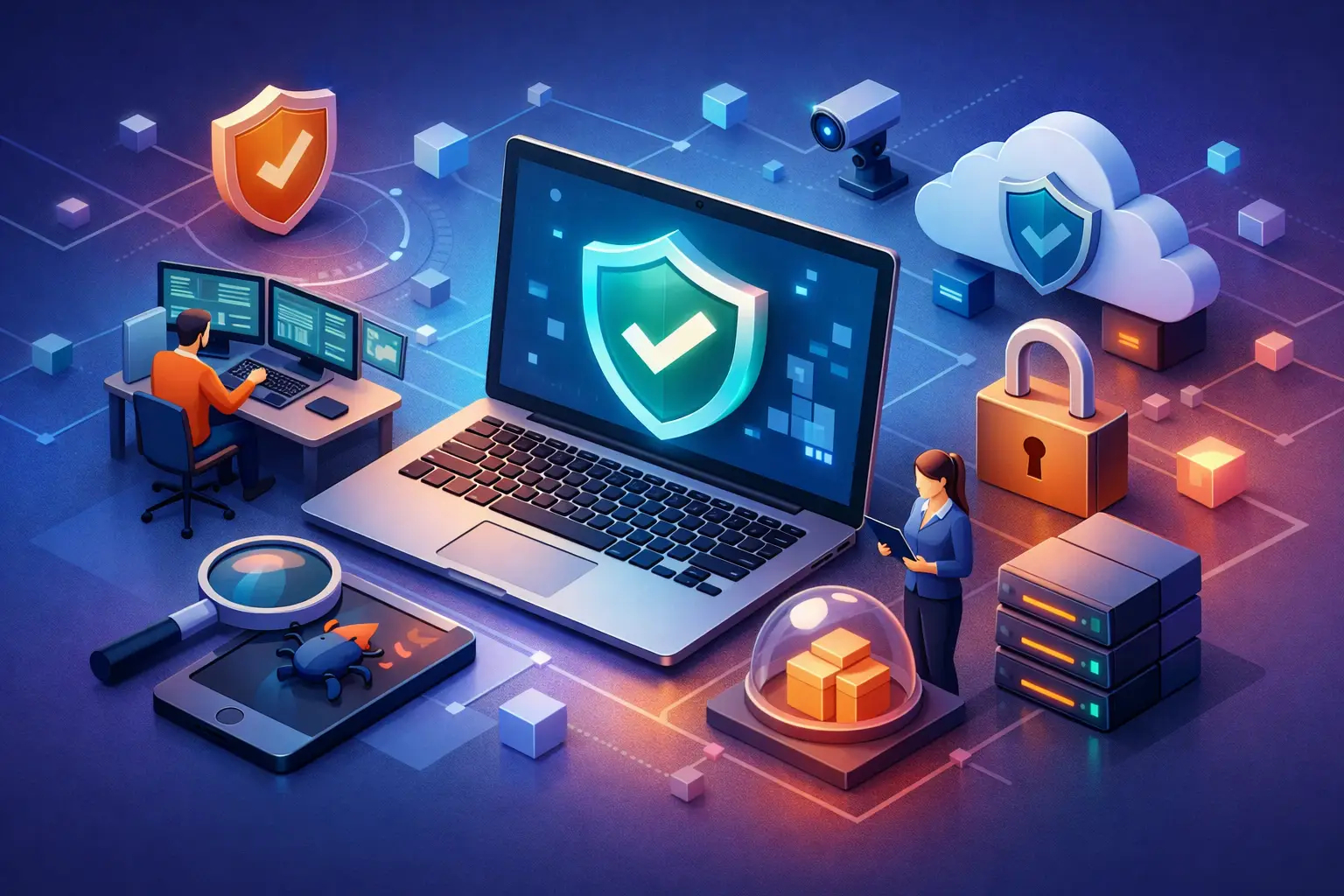
Managed EDR for Small Business That Works
A ransomware alert at 2:13 a.m. is not a tool problem. It is a leadership problem. If your company is relying on antivirus, a busy IT generalist, and hope, managed EDR for small businesses starts to look less like an upgrade and more like basic operational protection.
Small businesses are now facing the same attack methods that hit larger enterprises, but without the same bench strength. Threat actors do not care that your IT manager also handles onboarding, procurement, and printer issues. They care that one compromised laptop can become a path to payroll systems, customer data, or cloud admin access. That is where endpoint detection and response matter. More importantly, that is where managed delivery changes the outcome.
What managed EDR for small businesses actually means
EDR stands for endpoint detection and response. It is designed to monitor laptops, desktops, servers, and sometimes mobile devices for suspicious behaviour that traditional antivirus software often misses. Think command-line abuse, credential dumping, lateral movement, and unusual persistence mechanisms rather than just known malware signatures.
The managed part is what most small businesses actually need. Buying an EDR product gives you a console, alerts, and a long list of settings. Managed EDR adds trained analysts, triage, investigation, and response support. In practical terms, that means someone is reviewing alerts, separating noise from real risk, and helping contain threats before they spread.
That distinction matters. An unmonitored EDR platform can create a false sense of security. If nobody is watching the alerts, tuning detections, or escalating incidents with urgency, you have visibility without protection.
Why small businesses struggle with EDR on their own
Most small and mid-sized organizations do not fail because they chose the wrong security category. They fail because they underestimate the operating model required to make a control effective.
EDR is a strong example. The technology can be excellent, but it still needs policy decisions, deployment standards, response playbooks, escalation paths, and ongoing tuning. A lean internal team may be capable of handling some of that, but capability is not the same as available time.
This is where buyers often make a costly mistake. They compare managed EDR to the software license price alone. That is the wrong benchmark. The real comparison is managed service versus software plus analyst coverage plus incident readiness plus executive oversight. Once you frame it correctly, the economics change.
What good managed EDR should include
A credible managed EDR service does more than forward alerts. It should deliver continuous monitoring, analyst-led investigation, clear severity-based escalation, and practical response actions. If the provider only sends notifications and expects your team to figure out the next step, you are not buying much risk reduction.
You should also expect deployment support and policy tuning. Small business environments are messy by nature. Devices may be remote, lightly managed, or mixed across operating systems. A managed service should help close coverage gaps and reduce false positives, so your team does not start ignoring the noise.
Response quality matters just as much as detection quality. Some providers can isolate endpoints, kill malicious processes, or guide your IT team through containment. Others stop at alerting. That difference shows up fast during an active incident.
The business case for managed EDR
Executives do not need another dashboard. They need fewer avoidable disruptions, faster containment, and a stronger position with customers, insurers, and auditors.
Managed EDR helps reduce dwell time, which is the gap between compromise and containment. That gap is where financial damage grows. The longer an attacker stays active, the higher the likelihood of data loss, operational downtime, regulatory exposure, and recovery cost.
There is also a governance benefit. Small businesses under pressure to meet client security requirements or support frameworks such as SOC 2, ISO 27001, HIPAA, or PCI DSS often need proof that endpoint threats are being monitored and addressed. Managed EDR can support that story, but only when it is documented, reviewed, and tied to a broader security program.
That last point is important. Managed EDR is not a security strategy. It is one control within a strategy. If there is no incident plan, no asset inventory, no patch discipline, and no executive ownership of cyber risk, EDR will catch some issues, but it will not carry the whole program.
How to evaluate managed EDR for a small business
Start with coverage. Ask which endpoint types are supported, how quickly devices can be onboarded, and what percentage of your environment is realistically monitorable. If your business relies on remote staff, contractors, or bring-your-own-device exceptions, surface that early.
Then, examine service depth. Who investigates alerts? Is monitoring truly 24/7 or only during business hours? What happens when a critical detection fires overnight or on a holiday? Ask for the escalation process in plain English. You want to know who calls whom, how fast, and what authority exists to take action.
Next, look at response boundaries. Some managed providers will isolate a device immediately under approved conditions. Others require customer approval first. Neither model is automatically wrong, but the trade-off is speed versus control. A law firm, healthcare practice, or manufacturer may make different choices based on operational risk.
Reporting is another dividing line. A monthly PDF full of alert counts is not executive reporting. You need reporting that explains trends, incident outcomes, unresolved gaps, and decisions that require leadership attention. Security data is only useful when it supports action.
The trade-offs leaders should understand
Managed EDR is valuable, but it is not magic.
First, it does not replace preventive controls. You still need patching, MFA, email security, access management, backups, and user awareness. EDR improves your ability to detect and respond when prevention fails. It does not eliminate the need for prevention.
Second, not every provider offers the same operational maturity. Some are built around a strong platform but a thin service. Others provide capable analysts but weak communication. For a small business, communication quality is not a soft issue. It is operationally critical. If your provider cannot explain risk clearly during a live event, your internal team will lose time.
Third, managed EDR works best when it is aligned with leadership. If the service runs in isolation from the people who own the business risk, patterns get missed. Recurring endpoint issues may point to policy failures, vendor risk, weak offboarding, or shadow IT. Those are management problems, not just technical ones.
Where managed EDR fits in a maturing security program
For many growing companies, managed EDR is one of the first serious steps away from reactive IT support and toward structured cyber resilience. It gives smaller teams a way to improve detection without hiring a full in-house SOC. That is a strong move, especially when the company is scaling faster than its security function.
But the highest value comes when managed EDR is connected to governance. Alerts should inform risk reviews. Incident patterns should influence policy updates. Endpoint trends should shape training, access controls, and vendor decisions. This is why leadership matters. Cybersecurity requires direction, not just deployment.
That is also where providers like CISOLead stand apart when the conversation moves beyond tooling. Businesses do not just need someone to watch endpoints. They need a structured way to connect endpoint risk, compliance pressure, incident readiness, and executive accountability.
When managed, EDR is the right move
If your business has more than a handful of endpoints, stores sensitive data, supports remote work, or depends on cloud applications for daily operations, the answer is usually yes. The bigger question is not whether you need endpoint detection. It is whether you can realistically operate it well on your own.
For a very small company with a mature MSP, limited data exposure, and tightly controlled systems, a lightweight approach may hold for a while. For most others, managed EDR becomes necessary once the cost of downtime, fraud, or client trust erosion outweighs the monthly service fee. That threshold arrives sooner than many leaders expect.
The smart decision is not to buy the loudest product. It is to choose an operating model that gives your business a real chance to detect, contain, and learn from endpoint threats. If your security stack is growing but your decision-making still feels fragmented, start there. The best security tools become meaningful only when leadership turns them into outcomes.

Written by Ivan Energiev
IT Project Coordinator · Operations Excellence & Service Delivery Leader at Advanced Vision IT Ltd | Published on May 15, 2026
Ivan advises insights on IT project coordination, operations excellence, and service delivery leadership.Find out more about me
ADVANCED VISION IT - MALTA Address: Suite 8, Ta’ Mallia Buildings, Triq In‑Negozju, Zone 3, Central Business District, Birkirkara, CBD 3010, Malta
Registration number: C111282, VAT Number: MT31713827
Phone:+35679224404
Email: office@advisionit.com
ADVANCED VISION IT - BULGARIA
Address: 35 Dimitar Hadzhikotsev str. Ent A, Lozenets, Sofia, Bulgaria
ID No: 205789039, VAT No: BG205789039
Phone: +359 888 258 530
Email: office@advisionit.com