


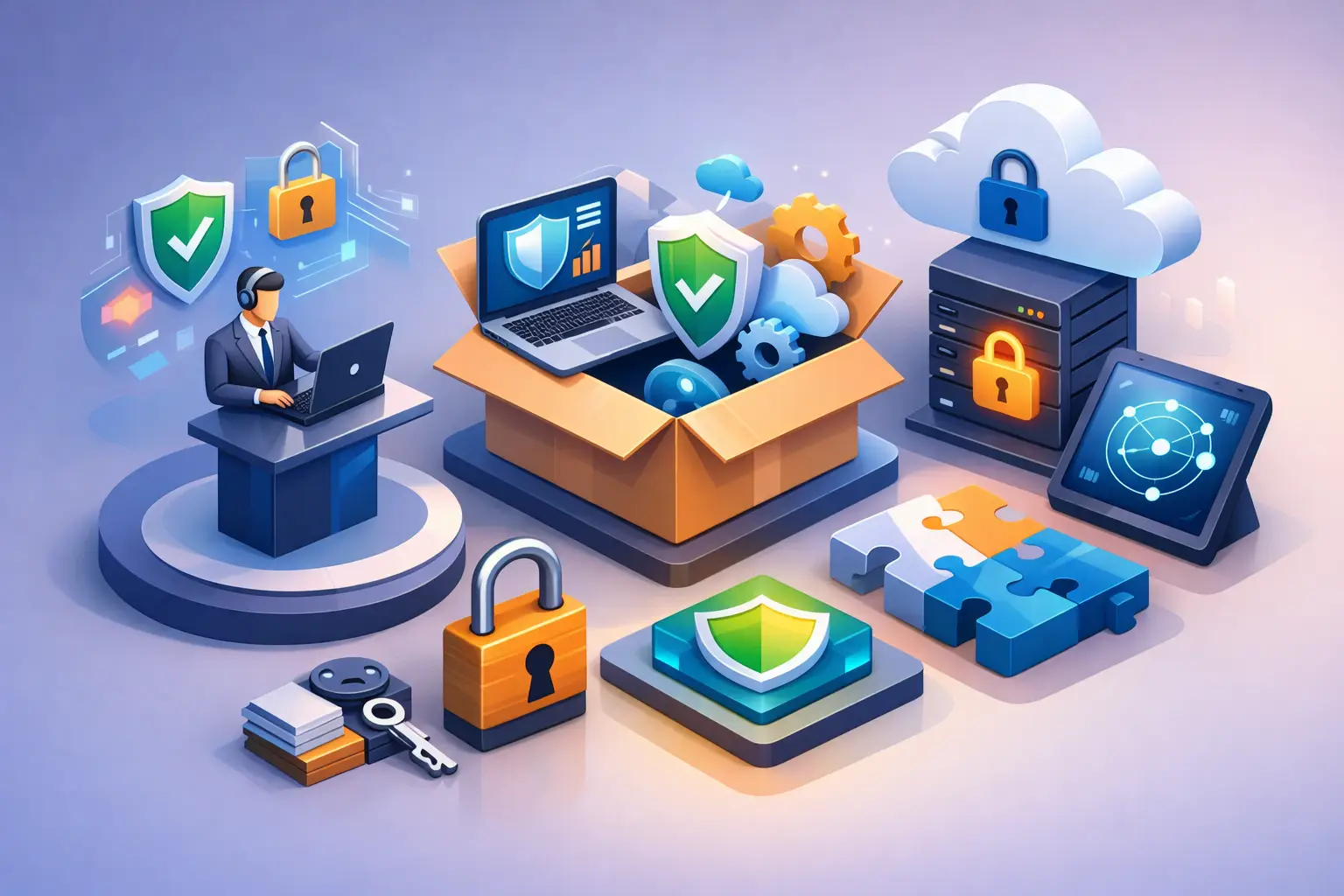
How Virtual CISO Packages Actually Work
Most companies do not fail at cybersecurity because they lack tools. They fail because nobody owns the decisions. That is exactly where virtual CISO packages earn their value. They give a business executive-level security leadership without the cost, delay, and hiring risk of bringing on a full-time Chief Information Security Officer.
For a founder, COO, IT director, or compliance lead, the real question is not whether security matters. It is whether your company has a clear security operating model. If policies are outdated, risks are not prioritized, vendors are selected without governance, and compliance work happens in bursts before an audit, the issue is leadership. A virtual CISO package is meant to fix that.
What virtual CISO packages are really buying
A lot of providers describe this service too narrowly. They position it as advisory time, a security check-in, or occasional guidance for IT. That framing misses the point. The right package is not a few hours of security consulting. It is a structured leadership function.
That function usually covers risk management, governance, policy direction, compliance alignment, incident readiness, and oversight of security controls. In practical terms, it means someone is responsible for turning cybersecurity into a business program instead of a scattered collection of tools and tickets.
This matters because most growing companies have already purchased technology. They may have endpoint protection, MFA, email security, backups, and maybe even a vulnerability scanner. Yet they still struggle to answer basic leadership questions. What are our top risks? Which gaps matter this quarter? Are we actually meeting customer and regulatory expectations? If we had an incident tomorrow, who would lead the response?
A strong virtual CISO package should answer those questions with structure, not guesswork.
Why companies choose virtual CISO packages
The obvious reason is cost. A full-time CISO is expensive, and many small to mid-sized businesses do not need one 40 hours a week. But cost is only part of the story.
The bigger driver is maturity. Many organizations are past the point where ad hoc IT support can cover security leadership, but they are not yet ready to build a full internal security department. They need governance, prioritization, and accountability now, not after a six-month executive search.
That is why virtual CISO packages often make sense for three types of companies.
The first is the growing business that has customers asking hard security questions. The second is the compliance-driven organization facing SOC 2, HIPAA, PCI, ISO 27001, or similar pressure. The third is the larger company that has technical staff but lacks senior security leadership to connect operations, reporting, and risk decisions.
In each case, the package works when it closes a leadership gap. It is less about filling a title and more about creating a decision-making structure the business can actually use.
What should be included in virtual CISO packages
Not every provider builds these services the same way, and that is where buyers need to pay attention. Some packages are heavy on advisory meetings but light on execution. Others are packed with tools but weak on governance. Neither is enough on its own.
The most effective virtual CISO packages usually combine strategic oversight with recurring operational support. That includes a current-state security assessment, risk register development, policy creation or revision, vulnerability review, incident response planning, compliance guidance, executive reporting, and regular leadership meetings.
For many businesses, monitoring and endpoint security oversight also belong in the package, especially when internal teams are stretched thin. If the provider includes EDR management, security monitoring, or vulnerability management, that can add real value. But those technical layers should support leadership, not replace it.
A package should also define cadence. Monthly reporting, quarterly roadmap reviews, policy milestones, and risk review sessions are not optional extras. They are what make the service operationally credible.
If a provider cannot clearly explain what happens in month one, month three, and month six, the package is probably too vague to drive meaningful security improvement.
What changes by package tier
Package tiers should reflect company complexity, not just company size. Headcount matters, but it is not the whole picture. A 75-person healthcare company may need more security leadership than a 200-person professional services firm. A SaaS company selling into enterprise buyers may face more pressure than a larger business with limited regulatory exposure.
That said, tiering usually follows a practical pattern.
Smaller organizations often need the fundamentals first - risk assessment, policy foundation, basic incident planning, security awareness direction, and support for customer security questionnaires. They are building a program from a relatively early stage.
Mid-sized organizations typically need stronger governance and more recurring oversight. That often includes formal vulnerability management reviews, compliance mapping, board-level or executive reporting, vendor risk input, and clearer metrics around remediation and maturity.
Larger or more complex organizations usually need a broader operating rhythm. They may require cross-functional governance, deeper audit preparation, coordination with internal IT and legal teams, security architecture input, and more frequent strategic engagement. At that level, the virtual CISO is often acting as an embedded security leader rather than an occasional advisor.
A serious provider should be able to explain exactly why one tier fits your business better than another. If the recommendation sounds generic, the service probably is.
How to evaluate virtual CISO packages without getting distracted
Buyers often compare packages by hours, deliverables, or included tools. Those details matter, but they are not the first thing to examine.
Start with ownership. Who is accountable for the security program moving forward? If the answer is still unclear after the sales conversation, the package is not solving the core problem.
Next, look at business alignment. Does the provider understand your regulatory exposure, customer expectations, operational dependencies, and growth plans? A virtual CISO should be able to connect security priorities to revenue protection, contract requirements, and operational resilience. If the conversation stays purely technical, the service is too shallow for executive use.
Then assess execution. Will policies actually be updated? Will risks be tracked and prioritized? Will someone lead incident planning? Will leadership receive reporting they can act on? Good virtual CISO packages create motion. They do not just produce recommendations that sit in a shared folder.
Finally, review the boundaries. Some businesses expect a virtual CISO package to function like a full managed SOC, internal compliance department, and strategic advisor all at once. That is not realistic unless the scope and pricing support it. The best providers are clear about what is included, what is optional, and what requires additional engagement.
The trade-offs leaders should understand
Virtual CISO services are not a magic substitute for internal ownership. They work best when there is at least one internal stakeholder who can coordinate action, whether that is an IT manager, operations leader, compliance manager, or executive sponsor.
There is also a trade-off between breadth and depth. A lower-cost package may give you strategic guidance and core governance, but not daily operational support. A broader package may include technical oversight and recurring management, but it still may not replace the need for in-house security engineering if your environment is complex.
This is why package design matters. The right fit depends on your risk profile, pace of growth, customer demands, and internal capability. Buying too little leaves leadership gaps in place. Buying too much creates cost without adoption.
The strongest engagements are designed around business stage and operating reality, not a one-size-fits-all menu.
When a virtual CISO package is the wrong fit
There are cases where this model is not enough. If your company needs daily executive security leadership across a large enterprise, heavy M&A activity, major international regulatory exposure, or a substantial engineering organization, a dedicated in-house CISO may be the better move.
It can also be the wrong fit if leadership is not ready to act. A virtual CISO can prioritize, advise, and lead, but if nobody internally will approve policy changes, fund remediation, or participate in governance, the service will stall.
That does not mean the model fails. It means the business has not committed to treating cybersecurity as a leadership issue.
What good looks like after six months
A well-run engagement should produce visible change. Risks should be documented and prioritized. Policies should be current. Compliance efforts should be more organized. Security decisions should have executive visibility. Incident response should no longer be improvised. Technical controls should be reviewed in the context of business risk, not tool marketing.
Most importantly, the company should have a clearer security direction. That is the real outcome buyers should expect from virtual CISO packages. Not more noise. Not another dashboard. Direction.
That is also why structured monthly models tend to outperform one-off consulting. Security maturity is built through cadence, accountability, and decisions made over time. A business does not become resilient because it bought software. It becomes resilient because someone is leading the program.
For organizations that need that leadership without building a full executive security function, a well-structured package can be the most practical move on the table. CISOLead is built around that exact need - giving companies a clear path to security governance, compliance progress, and operational resilience without pretending tools alone will get them there.
The right package should leave you with fewer open questions, sharper priorities, and a security program the business can actually run.
FAQ
1. What are companies really buying with a virtual CISO package?
Not “hours of consulting,” but a structured leadership function: risk, governance, policies, incident readiness.
2. Why do companies fail at cybersecurity?
Not due to missing tools — but due to missing ownership of decisions.
3. Why choose virtual CISO instead of a full-time CISO?
Cost, maturity, governance needs, customer pressure, hiring delays.
4. Which companies benefit most?
Growing firms, compliance-driven organizations, and companies with tech teams but no senior security leadership.
5. What should a strong virtual CISO package include?
Assessment, risk register, policies, vulnerability review, IR plan, compliance mapping, reporting, cadence.

Alexander Boychev
Published on: June 26, 2026 | Last Updated: June 26, 2026Business Executive & Digital Marketing Manager at Advanced Vision IT
Alexander bridges technology, sales strategy, and strategic marketing, specializing in key account management, digital growth initiatives, and enterprise cloud and cybersecurity solutions. Find out more about me