


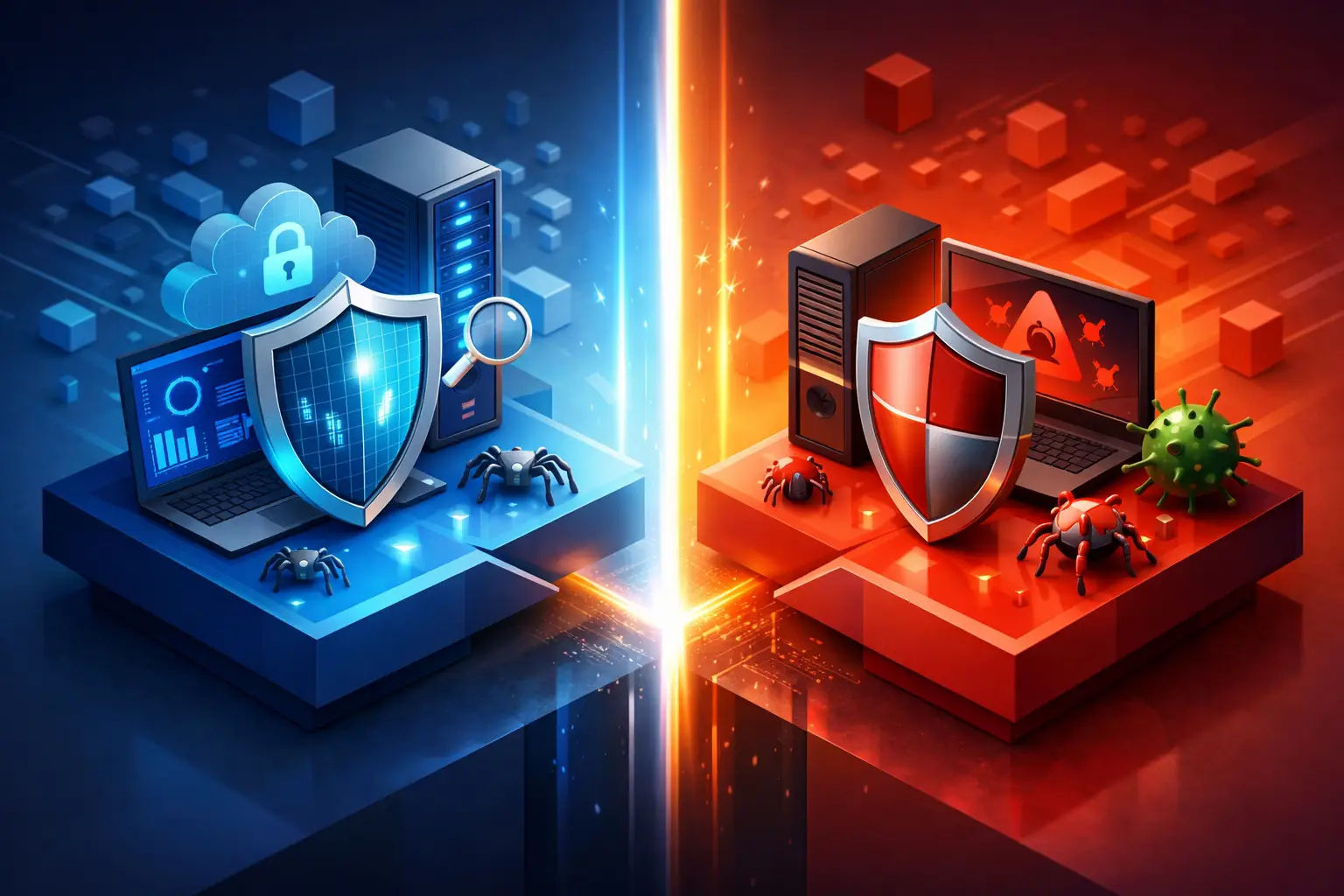
EDR vs Antivirus for Business: Which Security Solution Actually Protects Modern Organizations?
Modern cyber threats rarely rely on simple malware alone. Attackers increasingly use ransomware, credential theft, lateral movement, fileless attacks, and social engineering techniques designed to bypass traditional antivirus protection. This is why many organizations are shifting from conventional antivirus software to EDR (Endpoint Detection and Response) solutions that provide continuous monitoring, behavioral analysis, threat visibility, and faster incident response capabilities across the entire endpoint environment.
A finance lead approves a cybersecurity budget. IT asks for endpoint protection. A vendor says antivirus is enough. Another says only EDR counts. That is where bad buying decisions start. The real question in edr vs antivirus for business is not which acronym sounds more advanced. It is which control fits your risk, your team, and your ability to respond when something goes wrong.
Most businesses do not fail at security because they bought the wrong dashboard. They fail because they treat endpoint protection like a one-time purchase instead of an operating decision. Malware prevention matters. So does visibility, investigation, containment, and accountability when an endpoint is compromised. Those are different jobs.
Businesses looking to improve endpoint security, cyber resilience, and executive cybersecurity oversight can explore strategic CISO services.
EDR vs antivirus for business: the real difference
Traditional antivirus is built to prevent known threats from executing on a device. It relies heavily on signatures, reputation data, and basic behavioral rules to block malicious files or suspicious activity. For many years, that was the baseline. It still has a place, especially where risk is lower and environments are simple.
EDR, or endpoint detection and response, goes further. It is designed to detect suspicious behavior on endpoints, record telemetry, support investigation, and enable response actions such as isolating a machine, killing a process, or tracing lateral movement. Antivirus tries to stop the problem at the door. EDR assumes some threats will get inside and focuses on visibility and action.
That distinction matters because modern attacks do not always arrive as obvious malware. Credential abuse, living-off-the-land techniques, script-based attacks, and post-compromise lateral movement can bypass tools that are mainly tuned for file-based prevention. If your security model stops at antivirus, you may block common threats while missing the activity that causes the biggest business damage.
What antivirus does well
Antivirus is not obsolete. It is just narrower in scope than many buyers expect.
For small environments with limited exposure, good antivirus can provide meaningful value. It is generally easier to deploy, simpler to manage, and less expensive than a full EDR program. If your business has a small device footprint, a low-risk profile, and little internal capacity to investigate alerts, antivirus may be a reasonable starting control.
It also helps with hygiene. Known malware, commodity ransomware variants, and malicious downloads are still common. Blocking those threats before they execute reduces noise and lowers the burden on IT. For organizations that have done very little in endpoint security, antivirus is better than having no endpoint protection at all.
But that does not make it sufficient. Antivirus is a prevention tool first. Once an attacker uses valid credentials, PowerShell, remote admin tools, or legitimate system utilities, a basic antivirus product may offer limited context. At that point, your team is operating with blind spots.
Where EDR changes the conversation
EDR changes endpoint security from simple prevention to operational defense. That is a leadership issue, not just a technical one.
When a finance laptop starts reaching out to unusual domains at 2:00 a.m., EDR can surface the pattern. When a user launches a malicious script that spawns suspicious child processes, EDR can correlate the behavior. When a compromised machine needs to be contained before ransomware spreads, EDR can isolate the endpoint quickly.
This is why EDR tends to matter more as businesses grow, handle regulated data, support remote work, or rely on cloud identity and SaaS platforms. The risk is no longer limited to a bad file attachment. It is operational disruption, legal exposure, client trust, and executive accountability.
EDR also supports incident response maturity. Logs and telemetry help answer hard questions after an event: what happened, how far it spread, which users were affected, and whether the threat is truly gone. Without that level of visibility, leaders are often forced into expensive guesswork.
EDR vs antivirus for business by company stage
A ten-person company with basic systems does not need the same endpoint strategy as a multi-site healthcare provider or a fast-growing SaaS business handling customer data. Security decisions should reflect business stage.
Early-stage companies often start with antivirus because they need quick coverage and have no security operations function. That can be fine temporarily, provided leadership understands the limitation. The mistake is assuming a basic control will scale with the business.
Growth-stage organizations usually hit a turning point. More devices, more remote access, more vendors, and more compliance pressure create conditions where simple prevention is no longer enough. This is often where EDR becomes the smarter investment, especially if there is any concern about ransomware, cyber insurance requirements, customer due diligence, or audit scrutiny.
Larger businesses and regulated organizations should rarely frame this as an either-or decision. In practice, many endpoint platforms include prevention and EDR capabilities together. The real evaluation is not antivirus versus EDR as isolated products. It is whether your endpoint security program provides prevention, detection, response, and oversight in a way your team can actually operate.
The trade-off most buyers miss
EDR is more capable, but it is also more demanding.
If you deploy EDR and nobody reviews alerts, investigates suspicious behavior, tunes detections, or owns response decisions, you have bought visibility without control. That is not maturity. That is expensive noise.
Antivirus creates less operational burden because it is designed to block and move on. EDR creates more data, more alerts, and more decisions. That is useful only if someone is accountable for acting on it. For some organizations, that means building internal process. For others, it means using a managed service or aligning endpoint monitoring with broader security leadership.
This is where executives need clarity. Buying EDR does not automatically reduce risk. Operating EDR well reduces risk. There is a difference.
How to choose the right path
Start with your business risk, not the product category.
If an endpoint compromise would have limited impact, your environment is small, and your team lacks the capacity to run security operations, antivirus may be an acceptable baseline while you improve other controls. But if you process sensitive data, face contractual security reviews, support a distributed workforce, or cannot tolerate extended disruption, EDR is usually the more defensible choice.
Then assess response capability. Who investigates endpoint alerts? Who decides when to isolate a device? Who confirms an incident is contained? If those answers are vague, your gap is not just technology. It is ownership.
You should also factor in compliance and customer expectations. Many regulated environments and mature procurement processes increasingly expect stronger endpoint detection and response capabilities. Even when a rule does not explicitly say "buy EDR," the practical expectation is often there through logging, monitoring, incident response, and evidentiary requirements.
Cost matters, but it should be framed correctly. Antivirus is cheaper upfront. EDR may be more cost-effective over time if it shortens investigations, limits downtime, and reduces the blast radius of an attack. The cheapest endpoint tool is often the one that looks affordable until an incident turns into business interruption.
A business-first decision, not a tool debate
The endpoint security market likes clean narratives. Antivirus is old. EDR is modern. Real buying decisions are not that simple.
Some businesses need a layered endpoint platform with managed detection and response on top. Some need to replace outdated antivirus because their threat exposure has changed. Some are not ready for EDR until they define roles, escalation paths, and incident ownership. The right answer depends on your operating model as much as your threat model.
That is why cybersecurity requires leadership, not just tools. Endpoint protection should sit inside a broader plan that includes asset visibility, vulnerability management, identity controls, incident response, governance, and executive accountability. If you evaluate EDR or antivirus in isolation, you will likely overestimate what the tool can do and underestimate what your business still needs.
For organizations that do not have a full-time security executive, this is often where outside guidance creates the most value. A strong advisor does not just recommend a product. They define the role that product plays in reducing business risk and make sure someone owns the outcome.
A better endpoint decision starts with a blunt question: when a device is compromised, do you want a tool that tries to block it, or a security capability that helps your business detect, contain, and recover with confidence? Your answer says a lot about your current maturity and even more about what needs to happen next.
FAQ
1. What is the real difference between antivirus and EDR?
Antivirus focuses on prevention, blocking known threats. EDR provides detection, investigation, and response, offering visibility into suspicious behavior and enabling containment actions. As the text states: “Antivirus tries to stop the problem at the door. EDR assumes some threats will get inside.”
2. When is antivirus enough for a business?
It works for small, low‑risk environments with limited devices and no internal capacity for alert investigation. It is simpler and cheaper but offers limited context once attackers bypass file-based detection.
3. Why does EDR matter more as companies grow?
Because modern attacks use credentials, scripts, and lateral movement that antivirus cannot see. EDR provides visibility, telemetry, and rapid containment — essential for regulated, distributed, or cloud‑dependent organizations.
ADVANCED VISION IT - MALTA Address: Suite 8, Ta’ Mallia Buildings, Triq In‑Negozju, Zone 3, Central Business District, Birkirkara, CBD 3010, Malta
Registration number: C111282, VAT Number: MT31713827
Phone:+35679224404
Email: office@advisionit.com
ADVANCED VISION IT - BULGARIA
Address: 35 Dimitar Hadzhikotsev str. Ent A, Lozenets, Sofia, Bulgaria
ID No: 205789039, VAT No: BG205789039
Phone: +359 888 258 530
Email: office@advisionit.com