


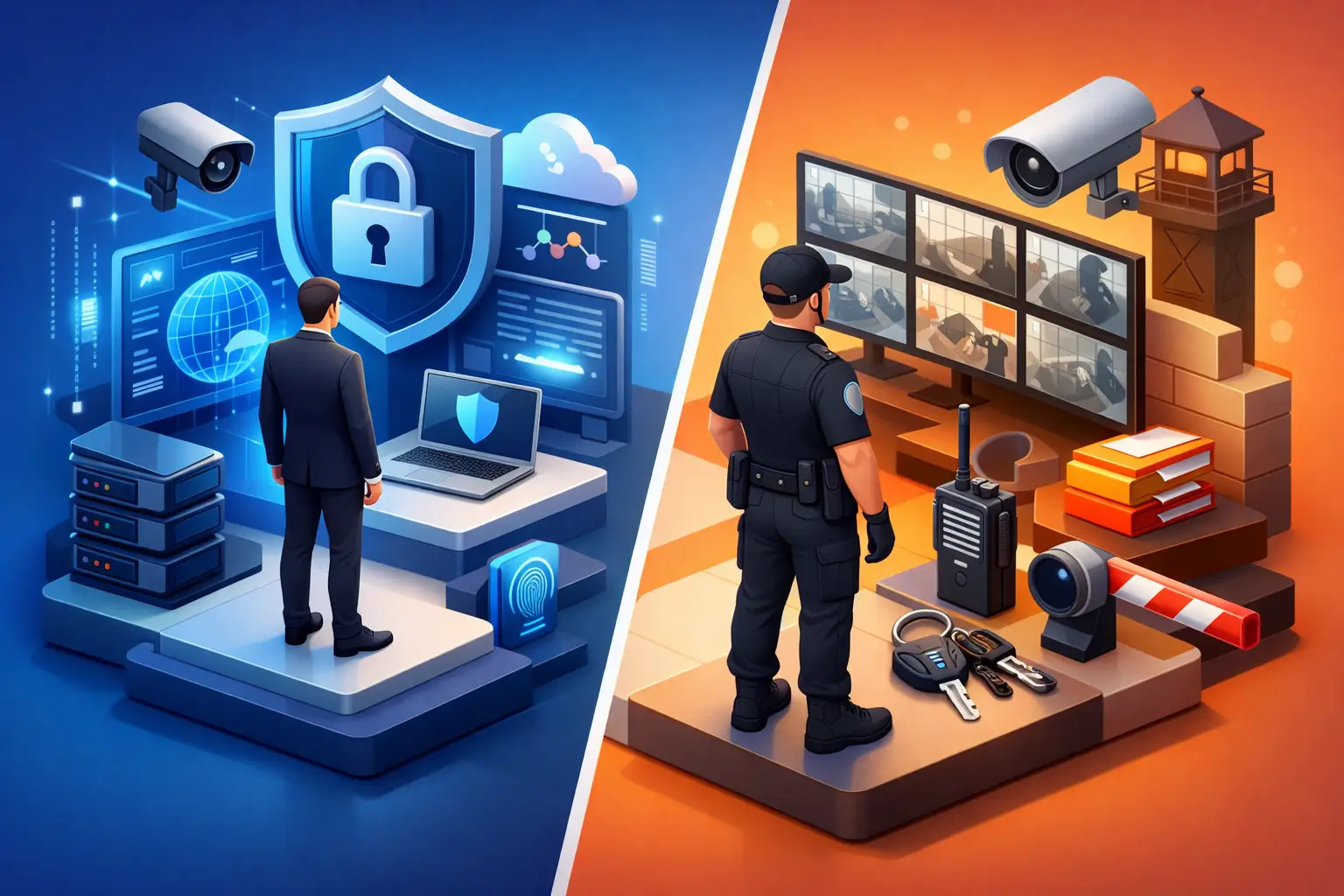
Difference Between CSO and CISO
If your board asks who owns security and the answer is vague, you do not have a title problem - you have a leadership problem. The difference between cso and ciso matters because these roles shape how your company manages risk, protects operations, and makes security decisions at the executive level.
A lot of businesses use the titles interchangeably. That creates confusion fast. One executive thinks about physical security, enterprise risk, and business continuity. Another is focused on cyber risk, governance, incident response, and regulatory exposure. When those responsibilities blur, accountability disappears.
For growing companies, this is more than semantics. It affects budget, reporting lines, compliance readiness, and how quickly you can respond when something goes wrong. If you are hiring, outsourcing, or restructuring leadership, you need to know exactly what each role is designed to do.
What is the difference between CSO and CISO?
At the highest level, a CSO usually has a broader security and risk mandate across the business, while a CISO is focused specifically on information security and cybersecurity.
That sounds simple, but the real answer depends on company size, industry, and maturity. In one organization, the CSO may oversee corporate security, fraud, investigations, physical site protection, resilience planning, and executive protection. In another, the CSO title may be used for a senior cyber leader who is effectively functioning as a CISO. Titles are not standardized across the market, which is exactly why leaders need to look beyond the acronym.
A CISO, by contrast, is generally much more consistent in scope. The role exists to lead the organization’s information security strategy. That includes cyber risk management, security governance, policy, controls, incident preparedness, vendor risk, regulatory alignment, and the protection of systems, data, and digital operations.
If your business is worried about ransomware, customer data exposure, audit findings, cyber insurance pressure, or security governance, you are usually describing a CISO problem, not a CSO problem.
The CSO role: broader enterprise protection
A Chief Security Officer often operates with a wider lens. The role may include both physical and digital security, but it can also stretch into operational resilience, crisis management, supply chain risk, and enterprise investigations.
In large enterprises, especially in sectors like manufacturing, logistics, finance, or critical infrastructure, the CSO can be a senior executive responsible for protecting the company as a whole. That may mean coordinating physical access controls, facility security, insider threat programs, executive travel risk, and cross-functional crisis response.
This is why the CSO role is often closely tied to corporate risk. It is not just about systems or data. It is about threats to people, assets, operations, and reputation. In some businesses, the CSO sits close to legal, operations, or enterprise risk leadership rather than IT.
That breadth is valuable, but it also creates trade-offs. A CSO with a very wide mandate may not go deep enough into cybersecurity architecture, technical controls, cloud security, or security engineering. If cyber risk is your primary exposure, broad oversight is not always enough.
The CISO role: cyber leadership with business accountability
A Chief Information Security Officer leads cybersecurity as a business function. That distinction matters. A real CISO is not just the person who approves tools or manages alerts. The role connects security controls to business risk, compliance requirements, operational resilience, and executive decision-making.
A strong CISO sets strategy, defines priorities, and builds accountability across the organization. That can include establishing a security roadmap, leading risk assessments, guiding policy development, shaping incident response plans, supporting audits, and translating technical weaknesses into business terms executives can act on.
This is also the role most organizations need before they realize they need it. Small and midsized businesses often buy security products without executive ownership. They end up with fragmented tools, inconsistent policies, weak reporting, and no one accountable for long-term cyber maturity. That is not a tooling gap. It is a leadership gap.
A CISO closes that gap by aligning cybersecurity with business realities. What is the actual risk? What are the compliance obligations? Where are the critical assets? Which controls matter now, and which can wait? Those are executive questions, and they need executive answers.
Difference between CSO and CISO in day-to-day practice
The easiest way to understand the difference between cso and ciso is to look at what each role is likely to own on a normal week.
A CSO may be reviewing a facility access incident, coordinating with legal on an internal investigation, updating a crisis escalation protocol, and assessing geopolitical or travel risk for leadership. The role is often cross-enterprise and threat-agnostic.
A CISO is more likely to be reviewing vulnerability trends, preparing for a compliance assessment, briefing leadership on cyber risk exposure, validating incident response readiness, and working with IT or engineering on security controls. The role is centered on information risk and digital trust.
There can be overlap. Both roles may participate in enterprise risk discussions, business continuity planning, and executive reporting. Both may also engage with the board. But the lens is different. The CSO protects the broader organization from multiple classes of threats. The CISO protects the organization’s information, systems, and cyber resilience.
Which role does your business actually need?
For most small and midsized companies, the answer is usually CISO, not CSO.
That is because most growing businesses are not struggling with executive protection or large-scale physical security programs. They are struggling with cyber risk ownership, policy maturity, audit preparation, vendor security, endpoint visibility, incident planning, and governance. Those are classic CISO responsibilities.
A full CSO model tends to make more sense in larger, more complex organizations with physical sites, sensitive operations, international exposure, or a mature enterprise risk structure. If you run multiple facilities, manage high-risk personnel, or need unified oversight across physical and digital domains, a CSO may be justified.
Even then, it is not always either-or. Some enterprises have both. The CSO owns enterprise-wide security and resilience, while the CISO owns cybersecurity within that structure. In other organizations, the CISO reports to the CSO. In others, the CISO reports directly to the CIO, CEO, or board committee. Structure depends on risk profile and operating model.
What should not depend on preference is clarity. If no one can explain who owns cyber risk in one sentence, governance is already weak.
Why title confusion creates real risk
Confusing these roles creates practical problems fast. Budgets get misallocated. Security initiatives stall. Compliance work gets treated like an IT side task. Incident ownership becomes unclear. Board reporting turns into vague status updates instead of risk-based direction.
This is especially dangerous in companies transitioning from reactive IT support to formal security leadership. The business knows risk is increasing, but it has not defined executive accountability. As a result, technical teams carry strategic responsibilities they were never meant to own, and executives assume controls are stronger than they really are.
That gap shows up during audits, incidents, and customer due diligence. It also shows up in growth. As companies move upmarket, enter regulated sectors, or face larger client security reviews, loose ownership stops being manageable.
The fix is not choosing the most impressive title. The fix is assigning the right mandate.
How to make the right call
Start with your risk profile, not your org chart. Ask what threats matter most to the business right now. If the major exposures are data protection, ransomware, customer trust, compliance, cloud security, and incident readiness, you need CISO-level leadership.
Then look at internal capability. If your IT team is keeping systems running but does not have executive security experience, adding more tools will not solve the problem. You need strategy, governance, and someone who can translate cyber risk into business decisions.
Also consider scale. Not every company needs a full-time executive immediately. Many need the function before they need the headcount. That is where a fractional or outsourced CISO model can make sense. It gives the business access to executive-level security leadership without forcing a premature in-house hire. For organizations trying to build maturity with discipline, that is often the smarter move.
At CISOLead, that is the core premise: cybersecurity requires leadership, not just products.
The better question for executives
Instead of asking whether a CSO or CISO sounds more senior, ask who is accountable for protecting the business in the ways that matter most. For many organizations, cyber risk is already a board-level issue whether the board has caught up or not.
The right leadership model is the one that gives your business clear ownership, informed decision-making, and measurable progress. Titles matter. Mandates matter more.
If your security strategy still lives inside tools, tickets, and scattered responsibilities, the next step is not another product. It is executive clarity.
FAQ
1. What is the core difference between CSO and CISO?
CSO → enterprise-wide security & risk. CISO → cybersecurity & information risk.
2. Why do titles create confusion?
Because CSO varies widely across industries, while CISO is more consistent.
3. When do you have a CISO problem, not a CSO problem?
Ransomware, data leaks, audits, insurer pressure, cloud security, governance.
4. What does a CSO typically handle?
Physical access, investigations, crisis management, travel risk, insider threats.
5. What does a CISO typically handle?
Vulnerabilities, compliance, policies, IR readiness, IT/engineering controls.

Written by Ivan Energiev
IT Project Coordinator · Operations Excellence & Service Delivery Leader at Advanced Vision IT Ltd | Published on May 09 2026
Ivan advises insights on IT project coordination, operations excellence, and service delivery leadership.
ADVANCED VISION IT - MALTA Address: Suite 8, Ta’ Mallia Buildings, Triq In‑Negozju, Zone 3, Central Business District, Birkirkara, CBD 3010, Malta
Registration number: C111282, VAT Number: MT31713827
Phone:+35679224404
Email: office@advisionit.com
ADVANCED VISION IT - BULGARIA
Address: 35 Dimitar Hadzhikotsev str. Ent A, Lozenets, Sofia, Bulgaria
ID No: 205789039, VAT No: BG205789039
Phone: +359 888 258 530
Email: office@advisionit.com