


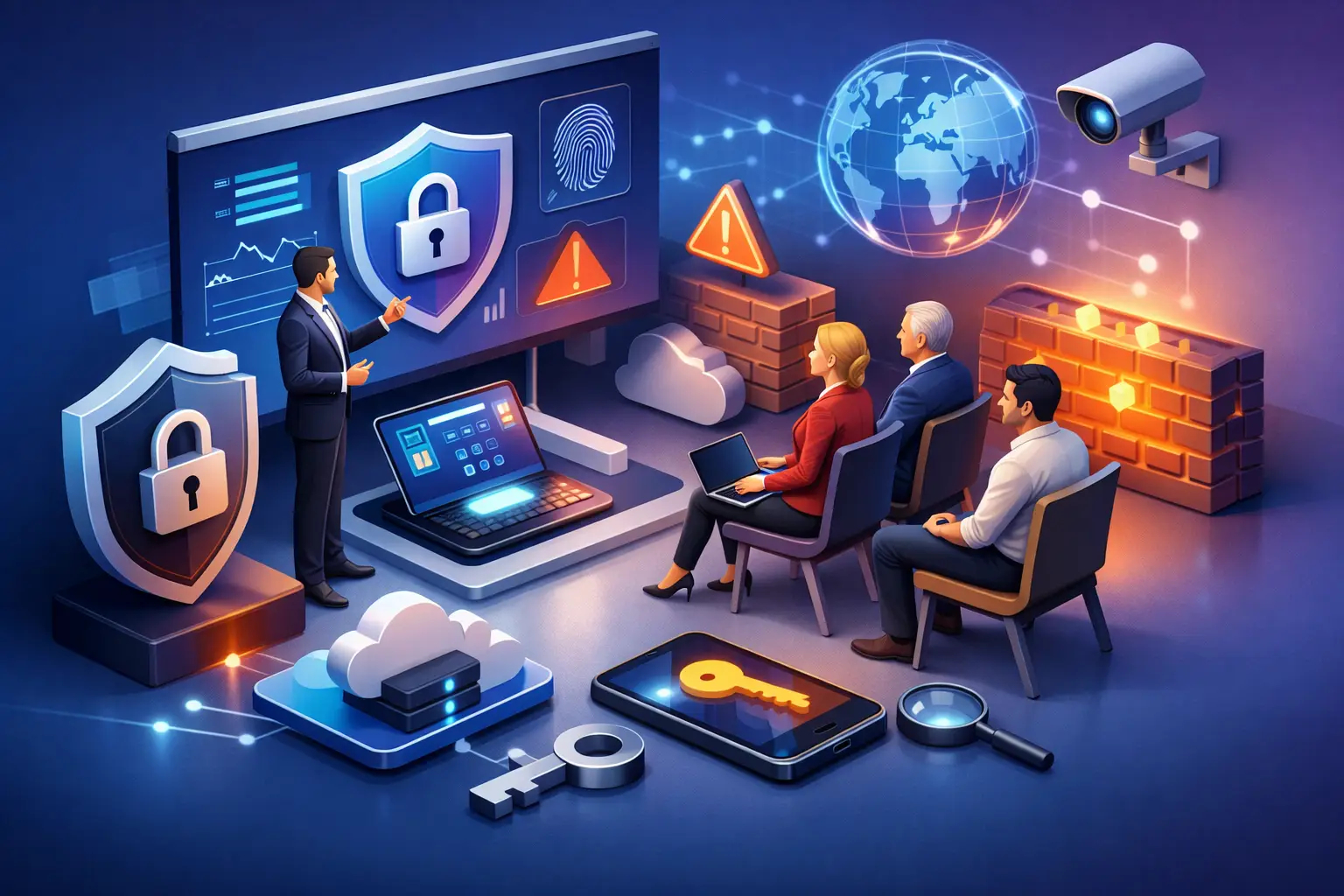
Cybersecurity Training for Executives That Works
Most executive teams do not fail cybersecurity because they ignored a phishing video. They fail because they made high-impact decisions without a clear view of cyber risk, regulatory exposure, or operational dependency. That is why cybersecurity training for executives needs to look very different from awareness training built for the broader workforce.
Executives are not being paid to memorize attack techniques. They are being paid to allocate capital, set priorities, challenge assumptions, and make sound decisions under pressure. If training does not improve those decisions, it is not executive training. It is wasted calendar time.
What cybersecurity training for executives should actually do
Executive training should strengthen leadership behavior around security. That means helping senior decision-makers understand where cyber risk affects revenue, operations, customer trust, legal exposure, and board accountability. The goal is not technical fluency for its own sake. The goal is governance, judgment, and action.
A useful program should help leaders answer hard business questions with confidence. What risks can we tolerate? Which systems create unacceptable concentration risk? How prepared are we to respond if a key vendor is compromised? Are we investing in controls that reduce material exposure, or just buying tools because the market says we should?
This is where many organizations get it wrong. They push executives through generic modules on passwords, phishing, and safe browsing. Those topics matter for employees. They are not enough for a CEO, COO, CFO, founder, or board-facing leader. Executive responsibility starts where general awareness ends.
Why standard security awareness misses the mark
Most awareness programs are built for scale. They are designed to reach every employee, deliver consistent messaging, and check a compliance box. That has value, but executive teams operate in a different risk lane.
Senior leaders influence mergers, vendor strategy, product launches, market expansion, insurance decisions, compliance posture, and crisis communications. A poor executive decision can create far more exposure than a missed phishing email. If training does not address these realities, it leaves the highest-leverage risk owners underprepared.
There is also a credibility issue. Executives disengage quickly when training feels generic, overly technical, or disconnected from business outcomes. They do not need another lecture on malware terminology. They need direct guidance on the decisions they are expected to make and the consequences attached to them.
The right content for executive-level security training
Strong executive training is built around decision-making scenarios, not technical trivia. It should cover how the organization defines cyber risk, who owns which decisions, and how leadership responds when assumptions break.
Governance and accountability
Executives need to understand their role in security governance. That includes oversight of policies, reporting structures, escalation paths, and approval authority. In smaller companies, this often gets blurry. Security may sit with IT by default, while risk decisions are made informally across finance, operations, and leadership.
Training should force clarity. Who approves risk acceptance? Who decides whether a ransom demand is considered? Who signs off on delayed remediation when budget is tight? If those answers are unclear before an incident, they will be chaotic during one.
Business risk and prioritization
A mature executive team understands that not all cyber risks deserve the same response. Some issues require immediate funding and direct leadership involvement. Others can be managed over time. Good training teaches leaders how to distinguish between noise and material risk.
That usually means translating technical findings into business impact. A vulnerability is not just a software flaw. It may be a path to downtime in a revenue-critical platform, a compliance violation in a regulated environment, or a customer trust event that affects retention. Executives need that translation if they are expected to prioritize correctly.
Incident leadership
When a major security event hits, the technical team handles containment and investigation. Leadership handles everything else that can go wrong. That includes legal decisions, external communications, customer commitments, insurer engagement, board updates, and operational trade-offs.
This is why tabletop exercises are often the most valuable part of cybersecurity training for executives. They expose weak decision paths before a real incident does. They also reveal where leaders overestimate readiness. Many teams believe they can handle a cyber event until they test a scenario involving ransomware, data theft, regulatory notification, and a critical vendor outage at the same time.
Regulatory and contractual exposure
Executives do not need a law degree. They do need to understand the practical implications of regulatory requirements, customer security commitments, cyber insurance conditions, and board reporting expectations. A missed control may not just be a technical gap. It may trigger audit issues, contract disputes, or disclosure pressure.
Training should frame compliance correctly. Compliance is not the finish line. It is a minimum operating threshold. Executive teams that confuse compliant with secure tend to underinvest in resilience and overestimate their defensibility.
How to structure executive cybersecurity training
The best format is usually short, focused, and recurring. One long annual session rarely changes behavior. Executive attention is limited, and business context shifts fast. A stronger model combines brief leadership sessions, scenario-based exercises, and periodic reporting tied to current risk.
For many organizations, quarterly sessions work well. They are frequent enough to keep security in the leadership rhythm without becoming background noise. Each session should focus on a specific decision area such as third-party risk, incident readiness, regulatory developments, or budget alignment.
The training should also reflect the company’s stage. A 75-person business with no dedicated security leader does not need the same level of detail as a global enterprise with a mature governance function. Smaller organizations usually need help with fundamentals such as ownership, risk visibility, and policy discipline. Larger organizations may need deeper executive alignment on metrics, reporting quality, and crisis leadership.
It also helps to separate what executives need to know from what security teams need to do. Mixing those audiences often weakens the session for both groups. Leaders need concise framing, relevant scenarios, and decision-focused discussion. Practitioners need technical depth, implementation detail, and operational follow-up.
What good training looks like in practice
If a program is working, executive behavior changes. Security starts showing up in strategic planning instead of only after procurement or during audits. Budget discussions become more disciplined because leaders can connect spending to measurable risk reduction. Incident exercises produce decisions faster because ownership is already defined.
You should also see better questions from leadership. Not “Are we secure?” but “Where are we most exposed, what assumptions are driving that view, and what are we doing about it?” That is a meaningful shift. It shows the organization is moving from vague reassurance to active governance.
There is a commercial payoff as well. Companies with stronger executive security discipline tend to move faster with enterprise customers, pass due diligence with less friction, and make cleaner decisions about vendors and compliance investments. Security maturity is not just defensive. It supports growth when managed correctly.
Common mistakes to avoid
One mistake is treating executive training as a one-time event after a scare. That usually creates short-term attention and long-term drift. Cyber risk changes too quickly for that model.
Another is overloading leaders with technical detail. Precision matters, but context matters more. If the room is debating jargon instead of business exposure, the training has lost the plot.
A third mistake is failing to tailor the material to leadership roles. A CFO, COO, CEO, and head of technology do not all need the same examples. Their responsibilities overlap, but their decisions differ. Good training recognizes that.
This is also where outside leadership support can help. A structured advisory model, such as the kind CISOLead delivers, can turn training from an isolated session into part of a broader governance discipline. That matters because the real test is not whether leaders attended. It is whether the business is making better security decisions six months later.
The standard to hold your program against
Executive cybersecurity training should leave leadership more capable, more accountable, and harder to surprise. If it does not improve risk conversations, incident decision-making, and governance clarity, it is not doing its job.
The strongest organizations do not ask whether executives need cybersecurity training. They ask whether their leadership team is ready to make high-stakes decisions when security affects revenue, operations, compliance, and trust at the same time. That is the standard worth training for.

Written By
Yavor Y. Zlatev
CEO & Executive Director at Advanced Vision IT| Published on June 01, 2026
Yavor leads strategic growth and technology operations at Advanced Vision IT, specializing in enterprise cybersecurity, cloud infrastructure, NIS2 compliance, and managed security service delivery. Find out more about me
ADVANCED VISION IT - MALTA Address: Suite 8, Ta’ Mallia Buildings, Triq In‑Negozju, Zone 3, Central Business District, Birkirkara, CBD 3010, Malta
Registration number: C111282, VAT Number: MT31713827
Phone:+35679224404
Email: office@advisionit.com
ADVANCED VISION IT - BULGARIA
Address: 35 Dimitar Hadzhikotsev str. Ent A, Lozenets, Sofia, Bulgaria
ID No: 205789039, VAT No: BG205789039
Phone: +359 888 258 530
Email: office@advisionit.com