


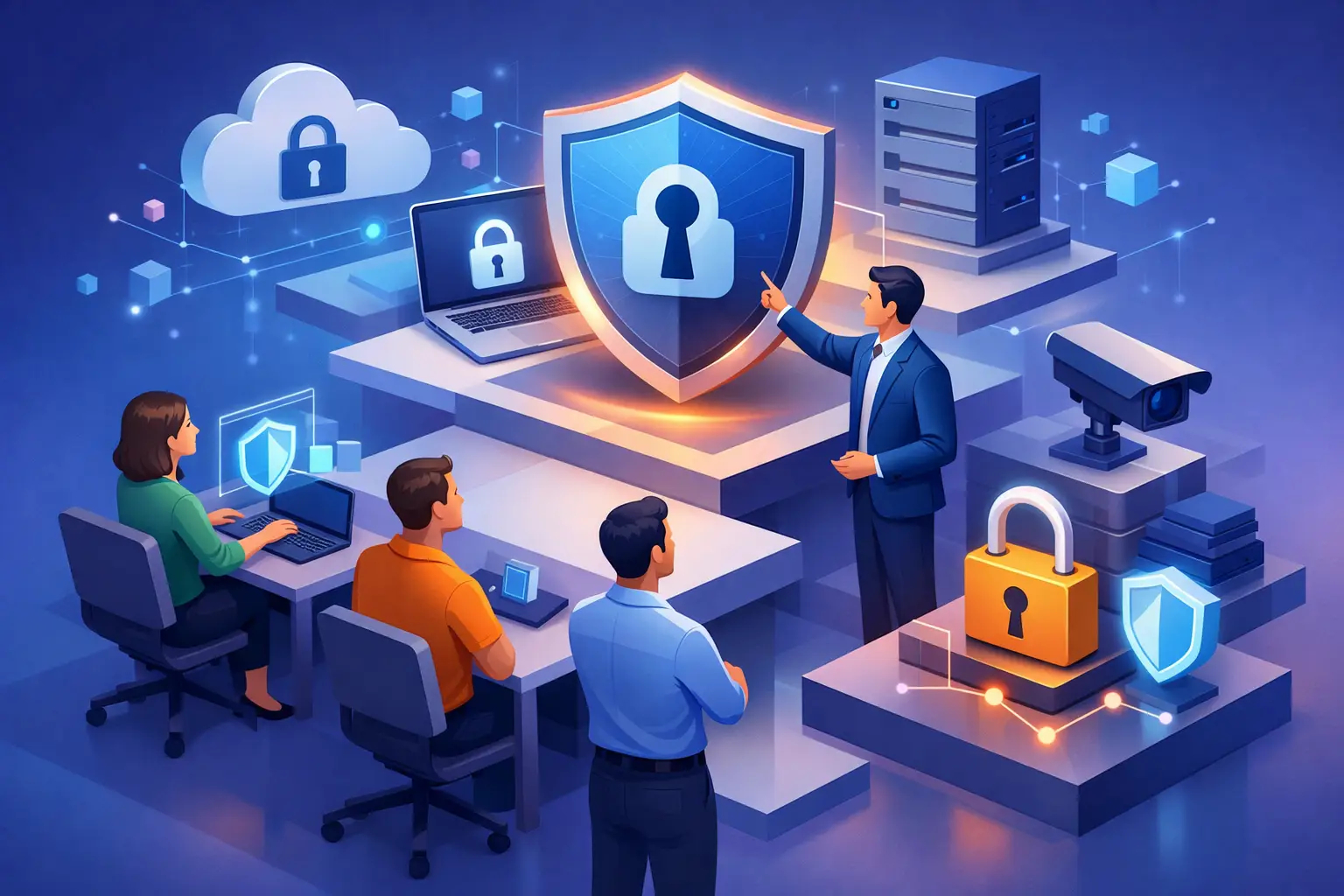
Cybersecurity Leadership for SMB That Works
A ransomware alert at 6:40 a.m. rarely fails because a business bought the wrong tool. It usually fails because nobody owned the decision-making before the alert ever appeared. That is the real case for cybersecurity leadership for SMB organizations. Small and mid-sized businesses do not lose ground only on technology. They lose ground on priorities, accountability, and speed.
Most SMBs already have something in place. They may have endpoint protection, MFA, backups, a cloud provider, an MSP, and a growing pile of compliance requests from customers. What they often do not have is leadership that connects those pieces to business risk. Without that layer, security becomes a collection of tasks instead of a managed program.
Why cybersecurity leadership for SMB matters more than another tool
Tools detect. Leadership decides.
That distinction is where many growing companies get stuck. A founder approves software renewals. An IT manager handles support tickets and vendor questions. A compliance owner scrambles to answer security questionnaires. Finance wants predictability. Operations wants uptime. Everyone touches cybersecurity, but nobody is steering it.
That gap shows up in familiar ways. Critical systems are not clearly ranked by business importance. Incident response plans exist in a folder but have never been tested. Vulnerability findings pile up because nobody defines what must be fixed first. A cyber insurance application gets completed with more optimism than evidence. The company is spending money, but not necessarily reducing risk in the right order.
Executive security leadership changes that. It sets risk priorities, defines governance, assigns ownership, and turns security from reactive cleanup into an operating discipline. For an SMB, that matters because resources are limited. You cannot protect everything equally, and pretending otherwise is expensive.
What real security leadership looks like in an SMB
In a large enterprise, a full-time CISO may build a team around governance, security operations, compliance, architecture, and vendor management. An SMB usually needs the same decisions made, just without the luxury of a full executive bench.
That is why cybersecurity leadership for SMB should be measured by outcomes, not titles. If leadership is working, the business knows which risks matter most, which controls are in place, where the gaps are, and what gets funded next. Security stops being vague.
It starts with business context
Security leadership should understand revenue dependencies, operational choke points, customer obligations, and regulatory pressure. A manufacturer has different risk priorities than a healthcare software company. A professional services firm with remote staff has different exposure than a business running on-prem infrastructure across multiple locations.
The right leader does not begin with a product catalog. They begin with the business model. What systems keep revenue moving? What data creates legal or contractual exposure? What outage would damage customer trust fastest? Those answers shape the program.
It creates a decision framework
An SMB does not need a hundred-page strategy document to act responsibly. It needs a clear framework for making consistent decisions. That includes risk tolerance, policy direction, escalation paths, vendor review standards, and a practical roadmap.
This is where many technical teams get relief. Good leadership removes ambiguity. It tells IT what must be handled now, what can wait, and what needs executive approval because it carries real business impact.
It translates security into management language
Boards, owners, and senior operators do not need jargon. They need clarity on exposure, consequences, costs, and trade-offs. If a security issue cannot be explained in terms of business interruption, legal exposure, customer impact, or financial loss, it will struggle to get traction.
Strong leadership bridges that gap. It makes security easier to fund because it ties action to outcomes.
The cost of operating without it
The absence of leadership is not always dramatic at first. In many SMBs, it looks manageable right up until growth exposes the cracks.
A company adds new SaaS platforms without formal review. It expands into a regulated market and realizes its policies are outdated. A customer asks for evidence of vendor risk management, incident planning, or logging oversight, and the business starts assembling proof after the request arrives. None of this is rare. It is what happens when security is handled as a side duty.
There is also a hidden financial cost. Businesses without leadership often overspend on overlapping tools while underinvesting in governance, testing, and response preparation. They buy what is visible and delay what is harder to package. The result is familiar - more spending, limited assurance.
That does not mean every SMB needs an internal executive hire immediately. In fact, many do not. A full-time CISO can be the right move for larger or heavily regulated organizations, but for many companies, that cost is premature. What they need first is consistent executive-level direction.
Where SMBs should focus first
The first priority is not perfection. It is control.
Start by identifying the business-critical assets and processes that would hurt most if disrupted. That usually means core financial systems, customer data environments, identity infrastructure, collaboration platforms, production systems, and backup integrity. Once those are clear, security decisions become more disciplined.
Next, establish governance that fits the size of the company. That includes ownership for policy, risk review, incident response, and third-party oversight. Governance does not need to be bureaucratic to be effective. It just needs to be explicit.
Then create a security roadmap tied to business milestones. If the company is pursuing enterprise clients, compliance and evidence collection may need to move up the list. If expansion is driving more remote operations, identity controls and endpoint visibility may be the bigger priority. If acquisitions are likely, integration risk should be part of the plan early.
The point is simple - security leadership should follow the business, not sit beside it.
Fractional leadership is often the practical answer
For many organizations, the most effective model is not hiring a senior security executive too early. It is accessing that capability as a structured service.
A fractional or virtual CISO model can give an SMB the governance, planning, risk oversight, compliance guidance, and executive reporting it needs without the fixed cost of a full in-house role. That approach works especially well when the company already has internal IT or managed service support but lacks strategic direction.
There are trade-offs. A part-time leader will not be embedded in every internal conversation the way a full-time executive would be. The quality of the arrangement depends on scope, cadence, and authority. If the role is treated as occasional advice with no executive access, results will be limited. If it is integrated into planning, reporting, and accountability, it can materially improve resilience.
This is where businesses need to be honest. Do you need another security dashboard, or do you need someone to decide what that dashboard means and what happens next?
What to ask before choosing a cybersecurity leader
Whether you are evaluating a hire, a consultant, or a CISO as a Service provider, ask direct questions.
Can they explain your top business risks in plain language? Can they prioritize controls based on impact rather than fear? Can they support compliance demands without reducing the program to checkbox work? Can they work with your IT team, not around it? Can they build reporting that helps leadership make decisions quickly?
The wrong fit will talk only about tools, threat feeds, and technical features. The right fit will talk about governance, operational risk, customer commitments, incident readiness, and measurable progress.
That difference matters because cybersecurity leadership for SMB environments is not about sounding sophisticated. It is about reducing uncertainty in a business that cannot afford confusion during a security event.
Security maturity is a leadership issue
Maturity is often misunderstood as a technical condition. It is not. It is an operating condition.
A mature SMB does not necessarily have the biggest stack or the largest budget. It has clear ownership, current policies, visible risks, tested response plans, disciplined vendor oversight, and leadership reporting that drives action. It knows where it stands and what comes next.
That is the value of executive security leadership. It gives growing companies a way to become deliberate instead of reactive. It aligns cybersecurity with operations, compliance, and growth. It replaces scattered effort with managed progress.
CISOLead is built around that reality. Many businesses do not need more noise. They need leadership that turns cybersecurity into a business function with direction, accountability, and results.
If your security program depends on whoever has time this week, the issue is no longer technical. It is structural. Fix that first, and every tool you already own gets a better chance to do its job.

Alexander Boychev
Published on: May 10, 2026 | Last Updated: May 10, 2026Business Executive & Digital Marketing Manager at Advanced Vision IT
Alexander bridges technology, sales strategy, and strategic marketing, specializing in key account management, digital growth initiatives, and enterprise cloud and cybersecurity solutions. Find out more about me
ADVANCED VISION IT - MALTA Address: Suite 8, Ta’ Mallia Buildings, Triq In‑Negozju, Zone 3, Central Business District, Birkirkara, CBD 3010, Malta
Registration number: C111282, VAT Number: MT31713827
Phone:+35679224404
Email: office@advisionit.com
ADVANCED VISION IT - BULGARIA
Address: 35 Dimitar Hadzhikotsev str. Ent A, Lozenets, Sofia, Bulgaria
ID No: 205789039, VAT No: BG205789039
Phone: +359 888 258 530
Email: office@advisionit.com