


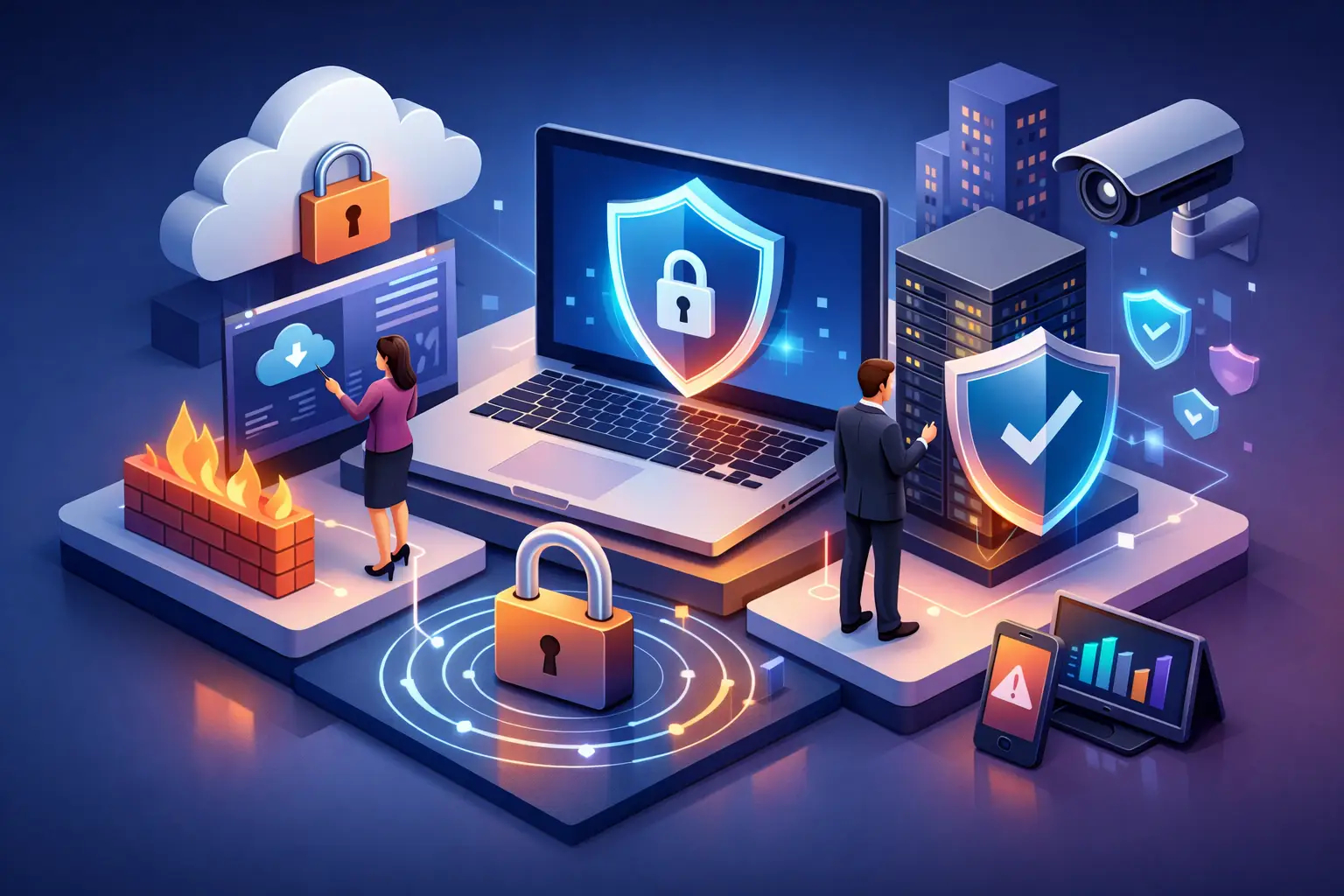
Cyber Resilience Strategy for Business
A ransomware event rarely starts with drama. More often, it starts with a normal workday, a delayed invoice, a user locked out of shared files, or an operations team asking why a critical system is suddenly offline. That is exactly why a cyber resilience strategy for business matters. The real issue is not whether an attack happens. It is whether your company can keep operating, make decisions quickly, and recover without losing customers, revenue, or control.
Many companies still treat cybersecurity as a shopping exercise. They buy another tool, add another alert feed, and hope the stack somehow creates protection. It does not. Cyber resilience is a leadership discipline. It connects governance, technical controls, incident response, compliance, and operational recovery into one business decision-making model.
What a cyber resilience strategy for business actually means
A cyber resilience strategy for business is not the same as a prevention plan. Prevention matters, but resilience assumes that some controls will fail, some users will make mistakes, and some threats will get through. The strategy is built around continuity. How fast can the business detect disruption, contain it, protect critical operations, and return to an acceptable state?
That question changes the conversation in the boardroom. Instead of asking, “Do we have the right tools?” leaders start asking, “Which business services cannot go down, what would downtime cost, and who owns the response when pressure is high?” Those are better questions because they tie cybersecurity directly to business risk.
This is where many small and mid-sized organizations struggle. They may have decent IT support, a handful of security products, and compliance requirements breathing down their neck. What they often lack is executive ownership. Without that, security efforts stay fragmented. Controls exist, but priorities are unclear. Monitoring is in place, but escalation paths are vague. Backup systems exist, but nobody has tested whether recovery will meet business expectations.
Start with business impact, not technical inventory
If you begin with a list of tools, you will end up optimizing technology instead of protecting the business. The smarter starting point is to identify the processes that drive revenue, customer trust, regulatory obligations, and day-to-day operations.
For one company, that may be its ERP and payment workflows. For another, it may be manufacturing systems, a customer portal, or protected health data. The point is simple: not every asset carries the same operational weight. A mature strategy ranks systems and data by business consequence, then aligns security effort accordingly.
This sounds obvious, but it is where resilience gets real. If leadership cannot define its critical services, it cannot make sound decisions during an incident. Teams will argue over priorities, waste time, and respond emotionally instead of strategically.
A practical exercise is to map the few services the company cannot afford to lose, then set acceptable downtime and data loss thresholds for each. That creates a decision framework for backups, monitoring, incident response, and vendor management. It also exposes uncomfortable truths. Some systems are more fragile than leadership assumes. Some dependencies live with third parties. Some recovery promises are fiction.
Governance is the control that holds the rest together
Cybersecurity requires leadership, not just tools. That is especially true for resilience. Someone has to own risk decisions, approve priorities, and force accountability across IT, operations, legal, compliance, and executive management.
Governance does not need to be bloated. For many organizations, it starts with a regular security leadership cadence, documented risk ownership, a current policy baseline, and a clear incident escalation model. The goal is not bureaucracy. The goal is faster, cleaner decision-making when conditions are messy.
This is also where businesses need to be honest about internal capacity. A growing company may not need a full-time CISO, but it does need CISO-level leadership. Without that layer, resilience efforts tend to become reactive. Projects stall. Compliance work becomes checkbox-heavy. Technical teams carry strategic decisions they were never meant to own.
Strong governance also keeps resilience tied to growth. Expansion into new markets, acquisitions, remote work, cloud migrations, and new regulatory exposure all change the risk picture. If cyber leadership is absent from those decisions, resilience will lag behind the business.
The operating model: prevent, detect, respond, recover
Most leaders understand prevention. Fewer give equal attention to detection, response, and recovery. That is where resilience is won or lost.
Prevention still matters. Baseline controls such as identity management, endpoint protection, patch discipline, vulnerability management, email security, and access governance reduce avoidable risk. But prevention alone creates false confidence. No control set is perfect, and attackers do not need many openings.
Detection must be aligned to what matters most. If your most critical systems are poorly monitored, your strategy is upside down. Logging, alerting, endpoint visibility, and behavioral monitoring should be designed around business-critical assets and known attack paths. More alerts are not the goal. Better signal is.
Response needs structure long before an incident occurs. That means named roles, communication workflows, decision thresholds, legal and regulatory considerations, and a documented playbook for the incidents most likely to hit your organization. Ransomware, business email compromise, vendor compromise, and data exposure are common priorities. The exact mix depends on your business model.
Recovery is where executive assumptions often collide with operational reality. Backups are essential, but backups without testing are a liability dressed as reassurance. Recovery plans must prove that systems can be restored within the time the business says it can tolerate. If your recovery objective is eight hours but your real-world restore takes two days, the strategy is broken.
Compliance helps, but it is not the strategy
A common mistake is treating compliance as proof of resilience. It is not. Compliance frameworks can improve discipline, document controls, and help establish governance. They can also create a dangerous illusion if leadership assumes that passing an audit means the company is ready for disruption.
The trade-off is straightforward. Compliance gives structure, but resilience demands execution under pressure. A policy may say incidents are escalated within one hour. Reality may say the right people were unreachable, the vendor contact was outdated, and no one wanted to shut down a revenue-generating system without executive approval.
That is why tabletop exercises matter. They reveal whether leadership can make hard calls with incomplete information. They expose bottlenecks, communication gaps, and hidden dependencies. They also force executives to confront the commercial impact of cyber risk in a way dashboards rarely do.
For regulated businesses, this discipline is even more important. Regulators and customers increasingly expect evidence that security is governed, tested, and tied to operational resilience. Not just documented.
Third-party risk is part of your resilience posture
Many businesses invest heavily in internal controls while overlooking external dependencies. That is a mistake. Your cloud providers, MSPs, software vendors, payroll systems, and managed platforms all affect your ability to operate through disruption.
A cyber resilience strategy for business must account for concentration risk and vendor failure. If a critical supplier goes down, gets breached, or locks your access during a dispute, what happens next? If the answer is “we are not sure,” you have a resilience gap.
This does not mean every vendor needs a massive review process. It means critical vendors should be identified, contractual expectations should be clear, and contingency planning should exist for the services you cannot easily replace. Practical beats theoretical every time.
What good looks like for growing companies
A mature program is not the one with the most products. It is the one with clear priorities, executive ownership, tested response, and controls mapped to business risk.
For a smaller company, that may mean formalizing policies, tightening identity controls, improving endpoint visibility, defining incident response, and testing backups against actual recovery expectations. For a mid-market business, it may also include vendor governance, board-level reporting, risk registers, recurring security reviews, and better integration between security, compliance, and operations. For larger organizations, the focus often shifts toward consistency across business units, more advanced monitoring, and governance that scales without slowing the business down.
The point is not maturity for its own sake. The point is operational confidence. When a cyber event happens, can your leadership team make fast decisions, protect critical functions, and communicate clearly to customers, staff, regulators, and partners?
That is the standard that matters.
At CISOLead, this is exactly why executive-level security leadership changes outcomes. Companies do not just need products deployed. They need risk translated into business decisions, resilience built into operations, and accountability that survives beyond a single project.
If your security program still depends on scattered tools, undocumented assumptions, or one overstretched internal team, resilience is weaker than it looks. The strongest next move is usually not another product. It is clearer leadership, sharper priorities, and a security model built to keep the business standing when conditions turn against it.

Written by Ivan Energiev
IT Project Coordinator · Operations Excellence & Service Delivery Leader at Advanced Vision IT Ltd | Published on May 31, 2026
Ivan advises insights on IT project coordination, operations excellence, and service delivery leadership.Find out more about me
ADVANCED VISION IT - MALTA Address: Suite 8, Ta’ Mallia Buildings, Triq In‑Negozju, Zone 3, Central Business District, Birkirkara, CBD 3010, Malta
Registration number: C111282, VAT Number: MT31713827
Phone:+35679224404
Email: office@advisionit.com
ADVANCED VISION IT - BULGARIA
Address: 35 Dimitar Hadzhikotsev str. Ent A, Lozenets, Sofia, Bulgaria
ID No: 205789039, VAT No: BG205789039
Phone: +359 888 258 530
Email: office@advisionit.com